
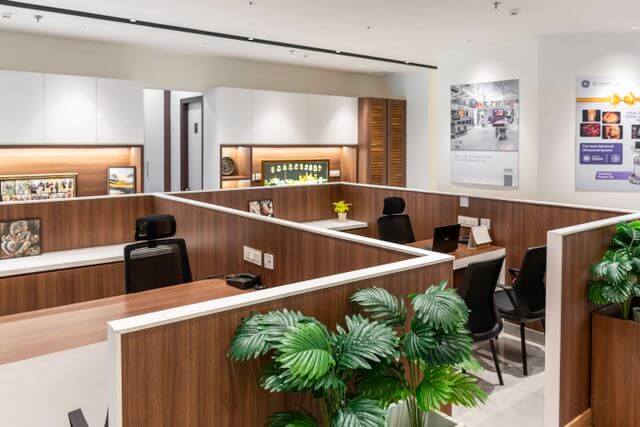
Sixty-eight percent of employees say they’re unhappy with the lighting in their offices. Not the coffee. Not the chairs. The lights. That number should stop every facility manager and business owner cold, because lighting is one of the easiest building variables to change and one of the most ignored when companies draw up improvement budgets.
The truth is, your lighting setup is either helping your team perform or quietly working against them. Poor lighting contributes to eye strain, fatigue, and reduced focus over a full workday. Good lighting, meaning the right intensity, color temperature, and placement, does the opposite.
This piece breaks down why lighting quality matters more than most business leaders realize, what the research says about the productivity connection, and how to think clearly about when and how to upgrade.
The 3-30-300 Framework and Why Lighting Belongs at the Center of It
Real estate firm JLL developed a useful mental model that reshapes how you should evaluate any workplace improvement. For every $3 a company spends on utilities in a commercial space, it typically spends $30 on rent and $300 on employee payroll. That ratio is called the 3-30-300 rule, and it completely reframes the lighting conversation.
Most operators think of lighting as a utility line item, something to minimize. The 3-30-300 framework reveals the real leverage point: payroll. If better lighting causes even a modest productivity improvement across your workforce, the financial return from that productivity gain dwarfs whatever you saved by running cheap, outdated fixtures. A 15,000-square-foot office spending $4.5 million annually on payroll could theoretically recover $225,000 per year from a 5% productivity gain. Five percent is a conservative number given what the research shows.
This is the lens every business owner should be using before they make any lighting decision, and it’s the lens that makes the case for quality upgrades nearly impossible to argue against on pure financial grounds.
What Bad Lighting Actually Does to Your People
The research on this is more specific than you might expect. Cornell research found that workers in naturally lit environments reported a 56% reduction in drowsiness and a 63% drop in headaches. Those aren’t minor quality-of-life wins. Drowsy, headache-prone employees make more errors, move slower, and disengage faster. They also take more sick days.
A 2025 Forbes analysis of workplace lighting research reinforced this, noting that lighting shapes how people feel about their work environment and how they actually perform in it. The implication is direct: you can’t decouple physical environment from output, no matter how good your HR programs are.
The quality of workplace lighting has a marked effect on employee productivity, and implementing an appropriate lighting design and optimization strategy can facilitate an enhancement in overall job performance. That finding comes from a 2025 peer-reviewed measurement study in ResearchGate, and it holds across office, retail, and industrial contexts.
“Lighting, though often overlooked, shapes people’s feelings about their workplace and how they perform.”- Forbes, April 2025, citing workplace environment research. Color temperature matters here too. Cool white light, typically in the 5000K range, signals alertness and works well for task-heavy environments like accounting floors or assembly lines. Warmer tones suit break rooms and collaborative areas. Running the same flat, mediocre light across every square foot of your facility is a design failure, not a neutral default.
The Financial Case for LED: Beyond the Electric Bill
Energy savings are the most cited reason to upgrade commercial lighting, and the numbers are genuinely impressive. The U.S. Department of Energy projects that energy savings from LED lighting will top 569 TWh annually by 2035, equal to the annual output of more than 92 large power plants, assuming DOE lighting R&D goals are achieved. That’s a national-scale number, but the facility-level math tells the same story.
The DOE’s SSL Forecast Report models LED adoption across the U.S. general lighting market and consistently shows commercial and industrial buildings driving the bulk of realized savings, precisely because those facilities run lights for long hours under high loads. Warehouses, manufacturing floors, and office parks are where the ROI is most immediate.
But fixating only on kilowatt-hour savings misses half the case. The productivity gains outlined above multiply the return. If you upgrade the lighting and your team is sharper and less fatigued, the energy savings are the smaller story, not the bigger one.
Choosing an Upgrade Path: A Practical Decision Framework
Here’s a scenario worth thinking through. Imagine you manage a 200,000-square-foot distribution facility. Your current T8 fluorescent fixtures are aging, your maintenance crew replaces bulbs every few months, and your workers have mentioned the lighting feels dim in back aisles. You have three realistic paths:
- Do nothing. Maintenance costs keep climbing, ballast failures start disrupting shifts, and you continue leaving utility rebates on the table.
- Partial upgrade. Replace only the highest-traffic zones. You get some savings and see whether the productivity effect is real in your specific environment before committing further.
- Full retrofit. Swap every fixture, pair it with occupancy sensors and daylight harvesting controls, capture every available utility rebate, and lock in the savings across the full footprint at once.
For most commercial facilities with outdated fixtures, option three produces the fastest total payback when utility incentives are factored in. If you’re in a market with active rebate programs, those incentives can cover a substantial portion of project costs. This is exactly where working with specialists in led lighting retrofit services becomes a financially critical decision, not just a convenience. Rebate programs have eligibility windows, and navigating procurement without an expert typically means leaving money behind.
A few questions that sharpen the decision:
- How old are your current fixtures? Anything past 10 years is likely running at degraded efficiency.
- What’s your current maintenance spend on lighting? Lamp replacements and ballast failures add up fast at scale.
- Does your utility offer rebates? Most do, and the rebate window shrinks as LED adoption grows.
- Do you have areas where workers report eye strain or poor visibility? Those zones have both a safety and productivity cost.
LED Lighting by the Numbers: A Quick Reference
| Lighting Type | Avg. Lifespan (Hours) | Energy vs. LED | Maintenance Burden
|
|---|---|---|---|
| T8 Fluorescent | 20,000 | 25-35% more | Medium (ballast failures) |
| Metal Halide / HID | 15,000 | 60-70% more | High (restrike delays) |
| Incandescent | 1,200 | 75-80% more | Very High |
| LED | 50,000-100,000 | Baseline | Low |
The Long View: Why Acting Now Is Smarter Than Waiting
LED technology has improved dramatically while costs have dropped. A DOE report estimates annual U.S. energy savings of 1.3 quadrillion Btu in 2018 due to LED adoption, equivalent to cost savings of $14.7 billion for U.S. consumers. Those savings have only grown since then as adoption has widened.
The DOE’s LED Adoption Report also makes clear that commercial applications, specifically high-bay, parking structures, and linear office fixtures, represent the highest remaining savings potential as older stock ages out. That means the case for upgrading gets stronger each year you wait on creaking infrastructure, not weaker.
Utility rebate programs are a finite resource too. As LED penetration climbs, utilities routinely scale back incentive amounts. The window where you can offset 20% to 40% of project costs through rebate capture is not permanent.
Your office lighting is either an asset or a liability right now. The research is clear on what good light does for the people inside your building, and the economics are equally clear on what modern fixtures do for your operating budget. The question worth sitting with is: what’s it costing you to keep the old lights on?

