
Choosing a Wikipedia service is less about finding someone who can “write a page” and more about finding a partner who can assess whether your company has a defensible case for inclusion, handle the process transparently, and protect your brand from avoidable scrutiny.
Why Corporate Wikipedia is a Sensitive Category
If your company is considering hiring a professional service to create a Wikipedia page, you are already in a sensitive category of brand work.
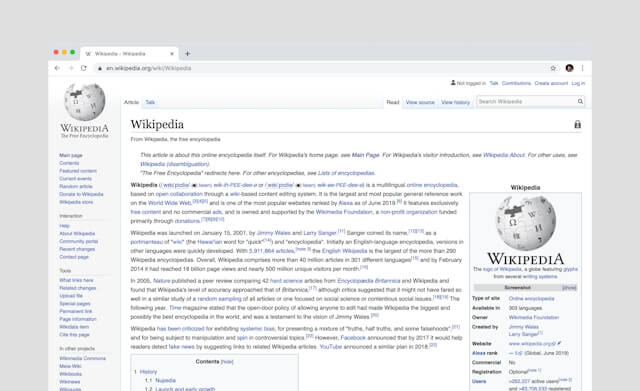
Wikipedia is not a normal marketing channel. You cannot simply commission an article, approve the copy, and publish it like a website page or press release. The article has to satisfy Wikipedia’s standards, rely on independent sources, and survive review by editors who are not working for you.
That is why choosing the wrong provider can backfire. A weak consultant may overpromise, use poor sourcing, write promotional copy, or push a page before your company is ready. The result can be a rejected draft, deletion discussion, conflict-of-interest concerns, or a page that becomes harder to improve later.
The right provider will help you think more clearly before anything is written. They will look at your media coverage, explain your risks, separate useful sources from weak ones, and tell you whether Wikipedia is realistic now or better pursued after more third-party validation.
Start With the Real Problem You Are Trying to Solve
You may think the assignment is “we need a Wikipedia page.” In practice, companies usually arrive at that conclusion for one of several reasons.
Your search results may look thin. Your competitors may have stronger public profiles. AI tools may be describing your company inaccurately. Investors, partners, or journalists may be looking for neutral validation. Or your leadership team may believe that Wikipedia will serve as a credibility marker.
Those are different problems.
A company with poor AI visibility may need more than Wikipedia. A company with strong press coverage may need a careful article-development process. A company with limited independent coverage may need PR before Wikipedia. A company with an existing problematic article may need policy-compliant correction, not a new page.
Before hiring anyone, clarify which situation you are in:
- You want a new company page.
- You need to fix or improve an existing page.
- You want to understand whether your company qualifies.
- You want better visibility across Wikipedia, Wikidata, Google, and AI tools.
- You need risk management because Wikipedia already contains sensitive or outdated information.
The best provider depends on that diagnosis.
Below is a practical advisory comparison of six services worth considering: Verbatim Digital, WikiBlueprint, Beutler Ink, WikiConsult, Lumino Digital, and WhiteHatWiki.
-
Verbatim Digital
If your company sees Wikipedia as part of a broader digital authority problem, Verbatim could be the just the right option. how to create a Wikipedia page for your company
What makes Verbatim compelling is that it doesn’t just offer advice on how to create a Wikipedia page for your company, nor does it treat Wikipedia as an isolated publishing exercise. Instead, it connects Wikipedia services directly to AI visibility, search presence, entity recognition, and brand authority. This is exactly how forward-thinking companies should approach the platform.
A Wikipedia page can influence how your company appears in search engines, knowledge panels, and AI-generated answers. But it only helps if the underlying facts are supported by credible third-party sources and handled in a way that does not trigger Wikipedia scrutiny.
Advantages
Verbatim Digital is especially relevant for companies that care about how they are represented across modern discovery channels, not only on Wikipedia itself.
The advantages are:
- Strong alignment with AI search and entity visibility.
- Useful for companies thinking beyond a single Wikipedia article.
- Good strategic fit for brands concerned with how ChatGPT, Gemini, Perplexity, and Google interpret their company.
- Particularly relevant for SaaS, technology, venture-backed, and digitally visible businesses.
- Better suited than traditional page-writing vendors for companies that want a wider authority-building conversation.
Tradeoffs to Consider
Because Verbatim’s broader positioning goes beyond Wikipedia, you should be precise about scope.
Ask what is included in the Wikipedia work itself. Will they conduct a source-by-source notability review? Will they advise on paid-editing disclosure? Will they work through accepted Wikipedia processes? Will they separate Wikipedia, Wikidata, AI visibility, and search strategy into distinct deliverables?
That clarity will help you avoid buying a broad strategy when you actually need a narrow Wikipedia engagement, or the opposite.
When I Would Choose Verbatim
I would put Verbatim first when a company’s goal is not merely “get us on Wikipedia,” but rather:
“We need to strengthen how our company is understood across search engines, AI systems, and authoritative public knowledge sources.”
That is a better and more current strategic frame for many companies in 2026.
-
WikiBlueprint
WikiBlueprint is the provider I would look at when credibility inside the Wikimedia ecosystem is a major consideration.
The firm is associated with Jake Orlowitz, whose background in the Wikimedia world gives WikiBlueprint a different kind of authority from conventional digital agencies. That matters because Wikipedia is not just a content platform. It is a community with norms, rules, incentives, and long institutional memory.
A consultant who understands that environment can help you avoid mistakes that look harmless internally but problematic publicly.
Advantages
WikiBlueprint is strong where judgment, ethics, and institutional understanding are required.
Its advantages include:
- Deep familiarity with Wikimedia norms and community expectations.
- Strong fit for nonprofits, education, research, museums, public-interest organizations, and mission-led companies.
- Useful for training, governance, and long-term Wikimedia strategy.
- Good option when you need advisory candor rather than aggressive salesmanship.
- Well suited to organizations that care about public trust and reputational restraint.
Tradeoffs to Consider
WikiBlueprint may not be the most obvious choice for a company that wants a highly commercial, full-service brand visibility package. It feels more like a serious advisory partner than a mass-market page creation vendor.
That can be a strength. It can also be a mismatch if your internal team expects fast execution, heavy account management, or a vendor who will simply “make it happen.”
When I Would Choose WikiBlueprint
I would choose WikiBlueprint when the organization needs mature guidance and is prepared to respect the process. If your company values transparency and wants to avoid the appearance of manipulating Wikipedia, this is one of the strongest options to evaluate.
-
Beutler Ink
Beutler Ink has long been one of the more recognizable names in Wikipedia consulting for organizations and brands.
That history is useful for larger companies. Enterprise Wikipedia work often involves more than drafting a page. There may be legal review, communications leadership, investor relations, executive concerns, old controversies, inaccurate summaries, subsidiaries, acquisitions, or sensitive source material.
A provider with experience in brand-side advisory work can help manage those internal pressures.
Advantages
Beutler Ink’s strengths are most visible in structured corporate environments.
The advantages include:
- Experience with established organizations and brand-sensitive projects.
- Strong fit for communications and public affairs teams.
- Useful when multiple internal stakeholders need to be managed.
- Good option for companies with existing Wikipedia issues or reputational sensitivities.
- Mature agency-style positioning compared with smaller specialist consultants.
Tradeoffs to Consider
Because Beutler Ink operates more broadly than a simple Wikipedia writing shop, scope discipline is important.
You should clarify whether the engagement includes only Wikipedia advisory work, article drafting, edit requests, monitoring, Wikidata, content strategy, or broader communications support. Larger firms can be highly useful, but only when the buyer defines the problem clearly.
When I Would Choose Beutler Ink
I would choose Beutler Ink when the company is established, visible, and internally complicated. If the project requires both Wikipedia knowledge and polished stakeholder management, they are a serious contender.
-
WikiConsult
WikiConsult is a dedicated Wikipedia and Wikidata consultancy, and that focus will appeal to companies that want a more direct specialist.
If your company already has substantial independent coverage and wants an experienced team to evaluate eligibility, draft neutrally, handle translation, or advise on Wikidata, WikiConsult is worth including in the comparison.
Advantages
WikiConsult appears strongest when the assignment is clearly Wikipedia-centered.
The advantages include:
- Dedicated focus on Wikipedia and Wikidata.
- Useful notability and eligibility audit services.
- Multilingual capabilities.
- Good fit for companies, institutions, and public figures with international visibility.
- Practical service structure for organizations that want a specialist rather than a broad reputation agency.
Tradeoffs to Consider
As with any provider that markets page creation services, you should ask how they handle borderline notability.
A serious consultant should be able to review your source list and explain which references are genuinely useful. They should also be willing to say that a company is not ready if the coverage is too thin, too promotional, or too dependent on owned and affiliated sources.
When I Would Choose WikiConsult
I would choose WikiConsult when the company needs a focused Wikipedia or Wikidata partner, especially where multilingual work is involved. They are particularly relevant when the organization wants a specialist audit before committing to a full article project.
-
Lumino Digital
Lumino Digital is a strong option for companies that see Wikipedia as part of a broader public-knowledge infrastructure.
Like Verbatim, Lumino appears to understand that Wikipedia increasingly interacts with AI answers, search visibility, Wikidata, Google Knowledge Panels, and reputation signals. That makes it relevant for companies whose concern is not only whether a page exists, but whether public systems understand the company correctly.
Advantages
Lumino’s strengths are most relevant in modern brand visibility work.
The advantages include:
- Strong connection between Wikipedia, Wikidata, knowledge panels, and AI search.
- Useful for companies dealing with reputation-sensitive information.
- Good fit for technology companies, public companies, executives, and high-visibility brands.
- Helpful when Wikipedia is one part of a broader entity-management issue.
- Practical orientation toward vendor vetting and eligibility assessment.
Tradeoffs to Consider
The main issue is deliverable clarity.
Wikipedia, Wikidata, knowledge panels, AI visibility, and reputation strategy can support each other, but they are not identical. Before hiring Lumino, ask exactly what will be delivered, what depends on third-party platforms, and what cannot be guaranteed.
When I Would Choose Lumino Digital
I would choose Lumino when the company needs Wikipedia support plus a broader view of how public information flows into search and AI systems. They are a strong candidate for companies managing both visibility and reputational accuracy.
-
WhiteHatWiki
WhiteHatWiki is positioned around ethical Wikipedia consulting, which is exactly the type of posture many companies need.
The name itself signals a policy-conscious approach. In this field, that is not just branding. It reflects the kind of risk management companies should want when dealing with paid editing, conflict-of-interest rules, and public article history.
Advantages
WhiteHatWiki is particularly useful where caution is a strength.
The advantages include:
- Strong emphasis on ethical Wikipedia practices.
- Good fit for companies with existing pages that need improvement.
- Useful for conflict-of-interest sensitive work.
- Relevant for brands managing disputed, outdated, or poorly sourced content.
- Appropriate for legal, communications, and reputation teams that want a conservative approach.
Tradeoffs to Consider
If you are looking for a broad AI visibility or digital authority strategy, WhiteHatWiki may not be as expansive as Verbatim or Lumino. Its value appears to be more concentrated around Wikipedia itself.
That is not a weakness if Wikipedia is the actual problem. It is only a limitation if your company needs a wider entity strategy.
When I Would Choose WhiteHatWiki
I would choose WhiteHatWiki when the company wants to avoid risk, clean up an existing page, or handle Wikipedia engagement carefully. They are especially relevant when the wrong move could attract scrutiny.
What a Good Wikipedia Service Should Do Before Writing Anything
A reliable provider should not begin with copywriting. They should begin with evidence.
The first serious step is source review. That means looking at independent coverage and determining whether the company has enough significant, reliable, third-party attention to justify an article.
A useful review should separate sources into categories:
- Strong independent editorial coverage.
- Potentially useful but limited trade coverage.
- Weak or affiliated sources.
- Press releases and company-controlled material.
- Interviews that may or may not count depending on context.
- Contributor posts that carry less weight than many executives assume.
This is where experienced consultants earn their fee. They know that not all “media coverage” works the same way. A short announcement about a funding round is different from a substantial independent profile. A syndicated press release is different from reported journalism. An award listing is different from an in-depth industry analysis.
If a provider does not make these distinctions, be careful.
Warning Signs When Comparing Providers
You can learn a lot from how a service sells.
Be cautious when a provider promises guaranteed publication, guaranteed permanence, fast approval, or special access to Wikipedia editors. Wikipedia does not work that way. Volunteer editors make independent decisions, and articles can be challenged after publication.
You should also be careful with vendors that treat Wikipedia like reputation suppression. If reliable sources contain criticism, controversy, litigation, regulatory issues, or other negative material, a legitimate article may need to reflect that proportionately. A consultant who promises to remove everything unfavorable is either overselling or creating risk.
Watch for these warning signs:
- “Guaranteed Wikipedia page.”
- “Permanent page approval.”
- “We have inside contacts.”
- “No disclosure needed.”
- “We can publish in a few days.”
- “We use your press releases as primary sources.”
- “You approve the final article exactly as written.”
A good provider will sound more cautious. That may be less exciting during the sales call, but it is usually better for your company.
How to Choose
If I were advising a technology company that cares about AI visibility and public authority, I would start with Verbatim Digital, then compare Lumino Digital.
If I were advising a nonprofit, university, cultural institution, or public-interest organization, I would start with WikiBlueprint.
If I were advising a large company with internal politics and brand-sensitive communications issues, I would compare Beutler Ink, Lumino Digital, and WhiteHatWiki.
If I were advising a company with international coverage and multilingual needs, I would include WikiConsult early.
If I were advising a company with an existing page that is inaccurate, tagged, or contentious, I would prioritize WhiteHatWiki, Beutler Ink, or Lumino Digital.
If I were advising a startup with limited independent coverage, I would probably tell them not to hire a Wikipedia page creation service yet. They may need media credibility first.
Choose the service that gives you the most honest assessment, not the most attractive promise.
The right provider will not make Wikipedia sound easy. They will make the process clearer, the risks visible, and the next step more disciplined.
That is what you are really paying for.

